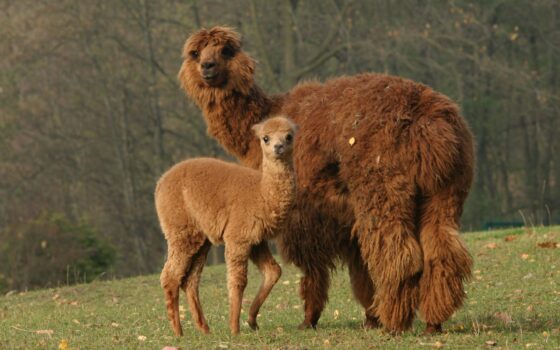
DISTRIBUTION AND HABITAT
Alpaca is found in South America only in the domesticated form. It lives in the Andes of Southern Peru, Western Bolivia, sometimes in Ecuador and Northern Chile, at an altitude of 3,500 to 5,000 m above sea level.
BEHAVIOUR
Alpaca is a herd animal. It lives in family groups consisting of the alpha male, the females and their young. Alpaca can be aggressive when it feels danger or wants to show its dominance. It can alert a herd about intruders by taking sharp, loud breaths that sound like high-pitched roars. Alpaca can attack smaller predators with its front legs, spit or kick.
DIET
In their diet, they mainly need pasture grass, hay or silage (biologically fermented forage).
REPRODUCTION
The female experiences induced ovulation, which means that the act of mating and the presence of the sperm cause them to ovulate. Alpaca can breed at any time of the year. Most reproduce in the fall or late spring. The gestation period is on average 11.5 months and usually one young, called cria (Spanish: baby) is born.The life expectancy of an alpaca is between 15 and 20 years.
GOOD TO KNOW
An alpaca, like a llama, can spit. A female alpaca spits up when she is not interested in the male. Both alpaca sexes keep others away from food or anything they keep an eye on.
- Latin name: Vicuna pacos
- IUCN –Red List – NE – not evaluated



Our Alpacas are sponsored by Galeria Bałtycka shopping center.
Galeria Bałtycka »